
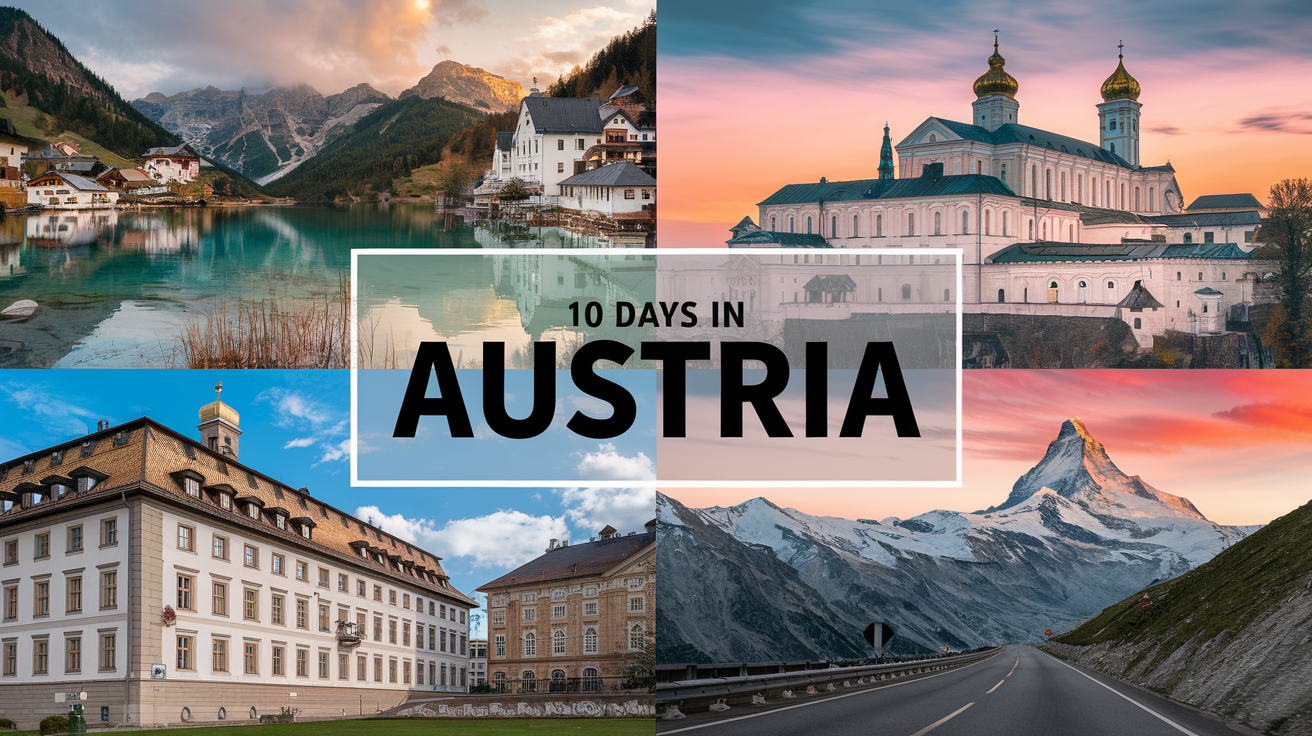
Austria, a land of imperial history, alpine landscapes, and cultural richness, is the ultimate European destination for travelers. Whether you’re captivated by Vienna’s grandeur, Salzburg’s musical legacy, or Hallstatt’s fairy-tale charm, this 10-day itinerary will guide you through Austria’s best. With detailed tips on attractions, tickets, dining, and more, planning your trip has never been easier!
Book your perfect holidays with Easyjet
Day 1–2: Vienna – The Imperial Capital
Why Visit Vienna?
Vienna, Austria’s capital, is a city of elegance and culture, known for its baroque architecture, coffeehouse culture, and musical heritage.
Must-See Attractions
Schönbrunn Palace (Schloss Schönbrunn)
- Description: A grand Baroque palace and former imperial summer residence with opulent rooms, formal gardens, a zoo, and the Gloriette hilltop monument.
- History: Originally a hunting lodge, it was transformed into a lavish palace by Empress Maria Theresa in the 18th century. It has over 1,400 rooms.
- Google Maps: Schönbrunn Palace
- ️ Opening Hours:
- Daily: 8:30 AM – 5:30 PM (seasonal variations)
- ️ Tickets:
- Grand Tour (40 rooms): €26
- Classic Pass (includes gardens, Gloriette, Maze, Zoo): €38
- Book here: schoenbrunn.at
- ℹ️ Tips for Visitors:
- Reserve tickets online to avoid queues.
- Arrive early for peaceful garden walks.
- Free access to the palace park; ticket needed for rooms and extras.
⛪ St. Stephen’s Cathedral (Stephansdom)
- Description: A Gothic masterpiece and the spiritual heart of Vienna with a colorful tiled roof and two tall towers.
- History: Built in the 12th century and expanded in the 14th and 15th centuries, it has survived fires and wars — a true symbol of Viennese resilience.
- Google Maps: St. Stephen’s Cathedral
- ️ Opening Hours:
- Daily: 6:00 AM – 10:00 PM (tours typically 9:00 AM – 5:30 PM)
- ️ Tickets:
- Cathedral entry: Free
- Catacombs + Tower + Treasury package: €20
- Book tours here: stephanskirche.at
- ℹ️ Tips for Visitors:
- Climb the South Tower (343 steps) for epic views.
- Attend a classical concert or organ performance inside.
- Modest dress is appreciated for church entry.
️ Belvedere Palace (Schloss Belvedere)
- Description: A twin-Baroque palace complex (Upper & Lower) set in manicured gardens, housing a major art collection, including Gustav Klimt’s The Kiss.
- History: Built by Prince Eugene of Savoy in the early 18th century as a summer residence. Later became a gallery for Austrian art.
- Google Maps: Belvedere Palace
- ️ Opening Hours:
- Daily: 10:00 AM – 6:00 PM
- ️ Tickets:
- Upper Belvedere: €17
- Combo ticket (Upper + Lower + Orangery): €26
- Book here: belvedere.at
- ℹ️ Tips for Visitors:
- Visit early to enjoy The Kiss without crowds.
- The gardens are free to explore.
- Photography allowed, but no flash inside galleries.
Dining Recommendations
Café Central: Famous for its Viennese coffee and pastries.
Figlmüller: Known for its giant Wiener schnitzel.
Day 3–4: Salzburg – Mozart’s Birthplace
Why Visit Salzburg?
Salzburg is a baroque masterpiece with a rich musical heritage and connections to *The Sound of Music*.
Must-See Attractions
Hohensalzburg Fortress (Festung Hohensalzburg)
- Description: One of Europe’s largest and best-preserved medieval castles, perched on a hilltop with sweeping views of Salzburg.
- History: Construction began in 1077. It was expanded over centuries and never captured, serving as a powerful symbol of Salzburg’s archbishops.
- Google Maps: Hohensalzburg Fortress
- ️ Opening Hours:
- Jan–April & Nov–Dec: 9:30 AM – 5:00 PM
- May–Oct: 8:30 AM – 8:00 PM
- ️ Tickets:
- Fortress + funicular + museums: €14.30 (online)
- Footpath + entry: €12.30
- Book here: salzburg-burgen.at
- ℹ️ Tips for Visitors:
- Take the funicular for convenience or hike up for great views.
- Arrive early or late afternoon to avoid crowds.
- Entry includes access to museums, state rooms, and lookout towers.
Mozart’s Birthplace (Mozarts Geburtshaus)
- Description: The house where Wolfgang Amadeus Mozart was born in 1756, now a museum about his early life, family, and musical genius.
- History: Located at Getreidegasse 9, this 18th-century house has become a pilgrimage site for music lovers worldwide.
- Google Maps: Mozart’s Birthplace
- ️ Opening Hours:
- Daily: 9:00 AM – 5:30 PM
- July & August: until 6:00 PM
- ️ Tickets:
- Adults: €12
- Students/Seniors: €10
- Children: €4
- Book here: mozarteum.at
- ℹ️ Tips for Visitors:
- Combine with a visit to Mozart’s Residence across the river.
- No photos inside; lockers available for bags.
- Plan ~1 hour for a full visit.
Mirabell Gardens (Mirabellgarten)
- Description: Beautiful formal gardens filled with statues, fountains, and flowerbeds — famously featured in The Sound of Music.
- History: Created in 1606 by Prince-Archbishop Wolf Dietrich as part of Mirabell Palace. Redesigned in Baroque style in the 18th century.
- Google Maps: Mirabell Gardens
- ️ Opening Hours:
- Daily: 6:00 AM – dusk (usually around 6:00–9:00 PM depending on season)
- ️ Tickets: Free
- ℹ️ Tips for Visitors:
- Visit early for photos without crowds.
- The Pegasus Fountain and Dwarf Garden are highlights.
- Great picnic spot with views of the fortress.
Dining Recommendations
St. Peter Stiftskulinarium: Europe’s oldest restaurant, offering traditional Austrian cuisine.
Augustiner Bräustübl: A historic brewery with hearty local dishes.
Day 5: Hallstatt – A Fairy-Tale Village
Why Visit Hallstatt?
Hallstatt, a UNESCO World Heritage Site, is famous for its picturesque lakeside views and ancient salt mines.
Must-See Attractions
Hallstatt Salt Mines (Salzwelten Hallstatt)
- Description: The oldest salt mine in the world, where visitors can ride a miners’ slide, see prehistoric tunnels, and enjoy panoramic views from the Skywalk.
- History: Salt has been mined here since at least 7,000 years ago, giving Hallstatt its wealth and name (“Hall” = salt).
- Google Maps: Hallstatt Salt Mines
- ️ Opening Hours:
- Mid-April – Early November: 9:00 AM – 4:30 PM (last tour ~3:30 PM)
- ️ Tickets:
- Adults: €36
- Children (4–15): €18
- Family + combo passes available
- Book here: salzwelten.at
- ℹ️ Tips for Visitors:
- Includes a funicular ride and guided tour.
- Wear sturdy shoes and bring a jacket (the mine is ~8°C inside).
- Don’t miss the Hallstatt Skywalk above the town!
Hallstatt Ossuary (Beinhaus)
- Description: A small chapel beneath St. Michael’s Church displaying over 1,200 artistically painted skulls stacked in neat rows.
- History: Due to limited burial space, bones were exhumed and painted with names, flowers, and dates — a unique blend of art and remembrance.
- Google Maps: Hallstatt Ossuary
- ️ Opening Hours:
- May–October: 10:00 AM – 6:00 PM
- November–April: limited hours or closed (weather dependent)
- ️ Tickets:
- Entry: €1.50–€2.50 (cash only, pay at the door)
- ℹ️ Tips for Visitors:
- Very small — 15–20 minutes is enough.
- Combine with a walk through the historic cemetery.
- Quiet, respectful atmosphere — no flash photography.
Day 6–7: Innsbruck – The Alpine Capital
Why Visit Innsbruck?
Nestled in the Alps, Innsbruck combines stunning natural beauty with rich history and vibrant culture.
Must-See Attractions
Golden Roof (Goldenes Dachl)
- Description: A late-Gothic oriel with 2,657 fire-gilded copper tiles, this glittering balcony is the symbol of Innsbruck’s Old Town.
- History: Built in 1500 for Emperor Maximilian I to observe festivals and tournaments below. The roof and murals celebrate his marriage and reign.
- Google Maps: Golden Roof
- ️ Opening Hours (Museum inside):
- Tuesday–Sunday: 10:00 AM – 5:00 PM
- Closed Mondays
- ️ Tickets:
- Museum entry: €5
- Free with Innsbruck Card
- Book onsite or via innsbruck.info
- ℹ️ Tips for Visitors:
- The museum is small but informative — plan ~30 minutes.
- Great photo spot from Herzog-Friedrich-Straße.
- Nearby: Hofkirche, Imperial Palace, and charming cafés.
Nordkette Cable Car (Nordkettenbahnen)
- Description: A scenic ride from the city center to the high Alps, offering panoramic views, hiking, skiing, and mountaintop cafés.
- History: The funicular opened in 1906; today’s modern line includes funicular + 2 cable cars reaching Hafelekar Peak at 2,300 meters.
- Google Maps: Hungerburg Station
- ️ Opening Hours:
- Funicular & cable cars: Daily, 8:00 AM – 6:00 PM (seasonal changes may apply)
- ️ Tickets:
- Roundtrip (Innsbruck → Hafelekar): ~€44
- Discounts with Innsbruck Card
- Book here: nordkette.com
- ℹ️ Tips for Visitors:
- Dress in layers — temperatures drop drastically at the top.
- Hafelekar is the best viewpoint; stop at Seegrube for lunch or snow activities.
- Great for sunrise/sunset photography in clear weather.
Dining Recommendations
Die Wilderin: Modern Austrian cuisine with local ingredients.
Gasthof Weisses Rössl: Traditional dishes in a cozy setting.
Day 8: Graz – A Culinary and Cultural Hub
Why Visit Graz?
Austria’s second-largest city offers a vibrant blend of old and new, with a UNESCO-listed old town and cutting-edge architecture.
Must-See Attractions
Schlossberg & Clock Tower (Uhrturm)
- Description: A forested hill in the city center with panoramic views, home to Graz’s iconic Clock Tower, fortress ruins, gardens, and cafés.
- History: A fortress has stood here since at least the 10th century. Napoleon partially destroyed the castle in 1809, but the Clock Tower was spared by citizen donation.
- Google Maps: Schlossberg
- ️ Opening Hours: Open 24/7 (Clock Tower outdoor area and hill access)
- ️ Tickets:
- Funicular: €3.20 one-way, €5.40 round trip
- Schlossberg Lift: €2.50 one-way
- Free if walking up the 260+ scenic steps
- Tickets onsite or part of Graz Card
- ℹ️ Tips for Visitors:
- Don’t miss the Clock Tower and Bell Tower.
- Best visited at golden hour for sunset views over the rooftops.
- Small restaurants and ice cream stands at the top.
Kunsthaus Graz (Graz Art Museum)
- Description: A bold, blob-like structure nicknamed the “Friendly Alien,” showcasing contemporary art and digital media.
- History: Opened in 2003 for Graz’s turn as European Capital of Culture, designed by architects Peter Cook and Colin Fournier.
- Google Maps: Kunsthaus Graz
- ️ Opening Hours:
- Tuesday–Sunday: 10:00 AM – 5:00 PM
- Closed Mondays
- ️ Tickets:
- Adults: €10
- Students/Seniors: €7
- Free with Joanneum 24h/48h Pass
- Book here: museum-joanneum.at
- ℹ️ Tips for Visitors:
- Don’t miss the Needle Eye viewing platform.
- Exhibits change frequently — check what’s on before visiting.
- Combine with a walk across Murinsel (Mur Island) nearby.
Day 9: Wachau Valley – A Scenic Wine Region
Why Visit Wachau Valley?
This picturesque valley along the Danube River is famous for its vineyards, medieval castles, and charming villages.
Must-See Attractions
Melk Abbey (Stift Melk)
- Description: A stunning Benedictine monastery perched on a cliff above the Danube, known for its grand Baroque architecture, gold-adorned interiors, and panoramic views.
- History: Founded in 1089 and rebuilt in Baroque style between 1702–1736, the abbey has been a center of learning, music, and monastic life for centuries.
- Google Maps: Melk Abbey
- ️ Opening Hours:
- April–October: 9:00 AM – 5:30 PM
- November–March: Limited tours only (check website)
- ️ Tickets:
- Adults: €15
- Students/Seniors: €13
- Guided Tour: +€3
- Book here: stiftmelk.at
- ℹ️ Tips for Visitors:
- Don’t miss the Baroque library and the frescoed church.
- Combine with a Wachau Danube cruise or cycling route.
- Nearby restaurants in Melk town offer great local food and apricot treats.
Dürnstein
- Description: A romantic riverside town famous for its blue Baroque church tower, wine terraces, and castle ruins where Richard the Lionheart was once imprisoned.
- History: Dürnstein’s history goes back to the 11th century. The English king was held in Dürnstein Castle (now a ruin) in 1192 during the Crusades.
- Google Maps: Dürnstein
- ️ Opening Hours:
- Town: Open 24/7
- Castle Ruins: Open year-round (footpath ~30 min uphill)
- ️ Tickets: Free to explore the town and castle ruins
- ℹ️ Tips for Visitors:
- Wear good shoes for the hike up to the castle.
- Taste local Wachau wines and apricot schnapps.
- Visit during spring or autumn for ideal weather and fewer crowds.
Day 10: Return to Vienna
Activities
Explore Vienna’s vibrant neighborhoods like Naschmarkt.
Take a Danube River cruise for a relaxing end to your journey.
Transportation in Austria
Trains: Austria’s train network is efficient and scenic. Use ÖBB Railjet for booking.
Car Rentals: Ideal for exploring alpine regions and rural areas.
Public Transport: Vienna and major cities have excellent metro and tram systems.
Estimated Budget
Accommodation: €80–€300 per night.
Meals: €15–€50 per meal.
Transportation: €10–€30 per day.
Attractions: €5–€40 per site.
Travel Tips for Austria
1. Currency: Euro (€).
2. Language: German; English is widely spoken in tourist areas.
3. Passes: Consider the Austrian Travel Pass for train and attraction discounts.
4. Packing: Comfortable walking shoes and layers for variable weather.
Conclusion
Austria’s blend of history, culture, and natural beauty makes it a dream destination for every traveler. From Vienna’s imperial palaces to the serene lakes of Hallstatt and the majestic Alps in Innsbruck, this 10-day itinerary ensures you experience the best of Austria.
Call-to-Action
Have you visited Austria or planning your first trip? Share your experiences and tips in the comments below! Don’t forget to subscribe for more travel inspiration.
AI Travel Tools